

Peking University’s Huang Yiping: Domestic Demand and Innovation to Drive Next Phase
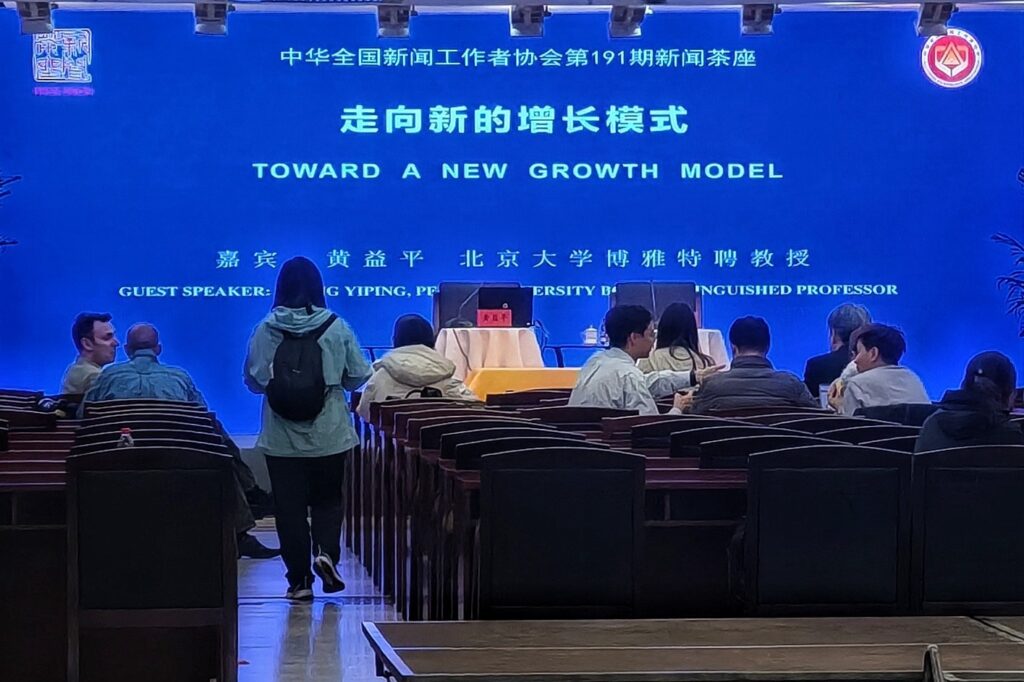
BEIJING, March 31 — China’s transition toward a “new growth model” took center stage at a media forum hosted by the All-China Journalists Association on Monday, where leading economist Huang Yiping outlined the country’s evolving economic strategy.
The event, attended by journalists from multiple countries, featured Huang—Dean of the National School of Development at Peking University and a member of the monetary policy committee of the People’s Bank of China—who provided a comprehensive analysis of China’s growth outlook, domestic demand, trade resilience, and innovation-driven development.
Clear Growth Targets, Stronger Policy Support
Huang noted that China’s government has set its 2026 GDP growth target in the range of 4.5% to 5%, supported by a more proactive fiscal policy and a moderately accommodative monetary stance.
He identified three key priorities for the year ahead:
Expanding domestic demand Developing “new quality productive forces” Mitigating risks in the real estate sector and local government debt
“The first two months of the year have shown a strong start, outperforming the same period in previous years,” Huang said, pointing to a rebound in fixed-asset investment—particularly in high-tech industries and infrastructure—as a key growth driver.
Consumption is also recovering, with retail sales gradually improving. Increased spending on social welfare and public services, he added, reflects a policy shift toward “investing in people.”
Prices Stabilizing, Structural Challenges Remain
Addressing inflation trends, Huang said that declines in the Consumer Price Index (CPI) and Producer Price Index (PPI) in recent months reflected imbalances between supply and demand, as well as excess capacity in some sectors.
However, he noted that price declines have narrowed since February and are expected to stabilize and recover gradually.
More broadly, Huang emphasized that China’s current economic slowdown is not merely cyclical but rooted in long-term structural challenges. The traditional growth model—heavily reliant on investment and exports—is facing constraints, particularly amid weakening global trade openness.
China, he said, is transitioning from an “international circulation” model to a “dual circulation” framework, in which domestic demand plays a leading role while international and domestic markets reinforce each other.
Boosting Consumption: Income and Confidence Are Key
On domestic demand, Huang highlighted structural constraints on consumption, noting that under labor-intensive growth models, household income growth has lagged and its share in the overall economy remains relatively low.
“To truly unlock consumption potential, two conditions must be met,” he said. “People need to have the income to spend—and the confidence to spend.”
He added that policy measures are being rolled out to raise incomes and strengthen social safety nets, aiming to reduce precautionary savings and encourage consumer spending.
Trade Resilience Amid Rising Uncertainty
Despite fluctuations in global demand, China’s exports have demonstrated resilience in recent years. However, Huang cautioned that rising protectionism could create uncertainty and encourage short-term corporate behavior that may undermine long-term competitiveness.
To counter these risks, he stressed the importance of fostering innovation and expanding domestic markets to strengthen economic resilience and sustain the dual circulation model.
Artificial Intelligence as a Future Growth Engine
On innovation, Huang noted that global perceptions of China’s technological capabilities are gradually shifting.
While acknowledging that China still has room to improve in foundational research, he emphasized the country’s strong ability to commercialize technologies, particularly in areas such as artificial intelligence.
“China benefits from rapid iteration, a large market, and significant economies of scale,” he said.
Although AI has not yet significantly boosted total factor productivity at the macro level, Huang noted that investment in the sector has surged and is expected to become a major engine of future growth.
On-the-Ground Observations
The forum lasted approximately 90 minutes, with Huang combining data and case studies to map out China’s economic transformation and the challenges ahead.
Questions from international journalists focused on the sustainability of growth, risks in the property sector, and shifts in the global economic environment—highlighting continued global attention on China’s policy direction.
In his concluding remarks, Huang emphasized that China is moving from high-speed growth to high-quality development, with long-standing structural imbalances gradually being addressed.
“This transition will not only shape China’s future,” he said, “but also have far-reaching implications for global supply chains, trade flows, and capital movements.”
Background
The All-China Journalists Association regularly hosts media forums to brief both domestic and international press on key policy developments. This session, focused on economic transformation, comes at the start of China’s 15th Five-Year Plan (2026–2030) period—a critical phase as the country seeks to stabilize growth while shifting to a more sustainable development model.
(Reported by Chang Yuzhang, Intern Reporter, Canada 24 News Agency, in Beijing)

